Sunday, October 10, 2010

Ring Road Days 5 & 6: Seyðisfjörður, Höfn, Jökulsárlón, Skaftafell

I'm going to combine two days as to give the last day a nice rounded-out summation, and Day 5 was much car-travelling. Brace yourselves.

Seyðisfjörður is quite nice, as I've said. There's a boat (more like a giant cruise ship) that docks once a week here and ferries people to Denmark! There are about five shops, a great art center, a Norwegian-looking blue church, and the scenery is lovely. Seyðisfjörður became even more memorable when Devon dropped the car key down a perfectly-placed drainage grate, and had to basically swim under the ditch to fetch it out. Luckily not only did we have a spare, but we (well, he) wrangled the key out without a full swim in the icy runoff of a waterfall. Nicole and I just documented the process. Isn't that our job as artists?! inoright.

There is an art piece nearby the grate of the ditch that conveniently also provided a place to sit, as well as wash off Devon's creek shoes.


The drive up the mountains and over the fjord is quite impressive. Nicole had plenty of opportunities to hunt for rainbows with all of the foggy/cloudy/misty/sunny weather one gets passing through the mountain range. Further down the Ring Road, we head south and stop in Djúpavík for a snack:

but sadly there was nowhere to get out and eat our lunch, no picnic tables, no community building, etc. So, we made the best of another meal in 'Café Bíl' (French and Icelandic for 'Car Café', obvi).

We then continued our drive to Höfn, through much rain and fog, some caused by Vatnajökull being so close by. Vatnajökull happens to be the largest glacier in Europe, so I can see why is would have an effect on the weather. It has ice that is over 1 kilometer thick at some points. However, tonight we were not able to see glaciers so we went to the fancy pool in Höfn, and I took another risk on my adventure trip and went down two waterslides! It's been a big growing-up time for Midnight Shoveler, now he is riding the Big-Boy Rides.

Day 6 far surpassed our expectations for sight-seeing. The things we experienced today made yesterday's rain seem like a worthwhile wait. We were finally able to see glaciers today, inching and groaning their way down from Vatnajökull.

But our main attraction for the morning was Jökulsárlón. It is a glacier 'lagoon', which formed only really in the last 75 years (I think I remember reading). When the glacier melts it calves icebergs off into this bay, and the icebergs float out to sea, under a bridge. The icebergs then either melt at sea, or some get stuck on the ocean coastline, which was almost even better than Jökulsárlón because here you have dramatically crashing waves and could walk up and touch (or lick, or pose with) 1,000-year old glacial ice.


The ice forms float around in the most amazing colors, textures, and sizes. Some are this intense blue color, others are clear, or have rocks and pebbled stripes in them. I heard one split off with a crack, and a chunk fell off into the bay- not quite as dramatic as calving off the glacier, but still sound-worthy.


Suffice to say we took a million pictures of this and decided not to go on the boat trip as we already had enough amazing moments, and still have more to see. Jökulsárlón is not actually very far from Reykjavík, drivable in a day, so I can bring friends back here too!

We drove a short ways to Skaftafell, a large national park and part of the Vatnajökull Nature Preserve. This was the most amazing change in landscape. One minute we are gazing at a blue iceberg in a rocky lagoon. And a half hour later we are in a true forest, with waterfalls, hiking trails, and hidden coves. The fall colors here were in full form!

We visited two great waterfalls, Hundarfoss and Svartifoss.

Hundarfoss (pictured below, from a distance) was my particular favorite because you could lean right over the edge of a precipice (carefully) and feel/see/hear the full effect of the falls.


Svartifoss, however, is more well-known waterfall, as it pours over a cliff of gorgeous basalt columns, all hexagonal and quite architectural.

You used to be able to walk behind this waterfall, but rocks and plants were being disturbed too much, so one can only walk up to the falls and gaze longingly, and then you have to turn back. This is probably a picture of me turning back.

There was a totally magical and surprisingly windless grotto at the bottom of the park, and we stopped for a moment to catch our breath, and look at some of the tallest trees on the island, and some of the oldest spruces as well.

We then headed reluctantly (I think we would have stayed longer but for the rain starting to pour on us) back to the car and drove to Vík, where we'll spend the morning of our last day of the trip. As we were on our way, yes, we did see the ash-y remains of Eyjafjallajökull's eruption. The mountain/glacier is not really see-able from the highway, but we did pass it. I naïvely thought that much of the volcano's destruction to the landscape would still be evident, but I believe the ash acted as fertilizer for many farms, so things are greener than ever in that area. There are a few mounds of black soils where you can tell the road was washed away and rebuilt, but it looks as if life is back to normal for much of the countryside on the south coast.

After a brief stop-in at the Vík wool factory where Devon and Nicole bought darling lopapeysas, we headed to our 70's-flavored guesthouse for the night. One more day of travelling and we'll be back to Reykjavík by the next nightfall. So much to think back upon, to try to process how much I've already seen this week. But don't worry, there's one more day, and we won't end our tour without a grand slam-bang finale.

(Many thanks to Nicole Pietrantoni who provided photos for about half of today's sights. You'll recognize her photos as they are the good ones, sized correctly and with a real artist's eye...)

Thursday, October 07, 2010

Ring Road Day 4: Námafjall and Dettifoss

This day is a little more manageable but includes two majorly impressive sights!

We drove from Húsavík back to the Mývatn area and stopped at what sounded awesome: Námafjall is an area of geothermal mud pits that sits on the increasingly widening fissure of the separating continental plates. This description did not disappoint. Some of the fissures in the ground go down 1500 meters and have 200-degree Celsius chemicals bubbling out of them. Acidity in the water of these pits creates the mud, as it slowly eats away at the outer layers of the pits, creating even more mud.


From here we drove to Dettifoss, the waterfall with the most volume flowing over it in all of Europe! It sneaks up on you after you drive for miles through through this barren wasteland-like field, and then walk for quite some time through lifeless piles of giant rocks, but then BAM.


You can get so close to nature here. In America, I think every natural sight worth seeing has a fence around it, and a concrete wall that you're forced to pay some toll/parking/tourist booth/security station for the privilege of seeing some Nature. But here, you're left to your own devices, like discovering some quicksand, clamboring across rocky precipices, or falling over a cliff to your demise ('cept that last one didn't happen).

We drove through more 'interior' of Iceland, which essentially is a desert- it's colder here, very little grows, though there are reindeer-crossing signs. We saw one reindeer on our way back home, too! There's a community as you drive toward Egilsstaðir with a whole lodge devoted to reindeer-inspired meetings.

We drove past the commerce town of Egilsstaðir and some weird American-looking homes (built pre-kreppa, perhaps, they look out of place and American Dream-y) and onto the delightful little town of Seyðisfjörður, nestled in the valley on the East Coast fjords. The hostel was in an old Hospital, but I thought this was kind of awesome! It still looked like a hospital inside- the floors were squeaky clean and I slid around on them, and the rooms and hallways were huge with giant windows.

Good night Seyðisfjörður, we'll see you briefly in the morning, and then we're off again.

Wednesday, October 06, 2010

Ring Road Day 3: Mývatn, to Húsavík

Brace yourselves, folks, this day is gonna be one of the most busy travels days we'll be having.

Stopping for a moment on Route 1 on the way to Mývatn, we took a break at Ljósavatn, a lake-filled area punctuated by one farm and one lone church in the wilderness. The church was built by an architect that I met at a party! He gave us excellent recommendations of sight-seeing places along our trip, including Ljósavatn. His church features a beautiful wall of windows behind the altar, so there is nothing to separate the congregation from nature. Quite beautiful.

Nearby was Goðafoss, a small but beautiful waterfall.


We arrived at Lake Mývatn and its surrounding countryside. I have been wanting to see Mývatn for several years; many of you might remember my orchestral thesis by the same name, which tried to imagine the sounds of birds, bugs, water, and volcanic eruptions in this area. I had only imagined what it would be like. I was delighted to be able to play my piece on my headphones while looking at the lake, and I think it was a good complement (and compliment) to the landscape if I do say so myself.

Mývatn is sort of a place like no other on Earth, where within the scope of just a mile or two there are landscapes ranging from New England-like trees (such beautiful and unexpected autumn colors!) and forested nature paths, to lava formations, hot springs, geothermal power plants, and separating tectonic plates. "Travel between North America and Europe in thirty seconds! Just don't fall into a mud pit and be boiled alive", the brochures should say.

We stopped next at Dimmuborgir, a lava field of unusual rock formations and home to the Yule Lads, Elf-like Troll dudes who (so the story goes) hide/live in the rocks until Christmas, when they appear one by one to parade around the country for the holidays. That's another story I'm sure I'll discuss at another time.

We drove right around the bend of Dimmuborgir and arrived at Bjarnarflag, a hotbed of geothermal vents and human-made attempts (sometimes successful, sometimes not) to capture the geothermal energy trapped beneath the ground by essentially plopping a power plant on top. We spend some time nerding around here, recording the steam sounds and photographing a million different Mars-like hills. Don't get too close, light-colored soil is a sign of something cooking underfoot and the ground could give way under you.


Bjarnarflag is also the site of a former algae plant which captured little particles for use in toothpaste, fertilizers, etc. But now, it's just a scary, otherworldly lake, dangerous, probably toxic, and totally jaw-dropping. There are several pipes of runoff water which shoot into the lake violently, half-boiling and half just making a scary ruckus.


I've never really been to a place before that felt physically like this-it really gave me a sense of real potential danger, I was frankly a little scared but also exhilarated. The ground rattles at some places with the force of steam coming out of the ground.

Even the puddles have a strange glow from minerals in the soil. This is the Earth at work! It's not humans that somehow f-ed up the ground here (well, except for that fake Blue Lagoon), it's Nature just doing its millenia-long thing. This hot steaming waterfall here, this sizzling pile of rocks there- it's happening, for realz, no DisneyHollywoodification about it.

On to something more relaxed: a safe version of the toxic lake we just visited. The Mývatn Nature Baths (Jarðböðin). Like it's big brother the Blue Lagoon near Keflavík Airport, this swimming pool was a delight after a windy day and a great place to swim in the mineral-rich lagoon. I naïvely expected the ground underfoot to be white, like the bluish-white waters. But it's black lava sands (silly me).


We drove to Húsavík to spend the night, which was a much shorter drive than expected, through barren fields and cracking tubes of lava that looked like giant black loaves of bread. We spent the night in an older couple's guest house, and the owner only spoke Icelandic with us. We were essentially sleeping in his children's old bedrooms, and we felt a little awkward using his kitchen while he and his wife watched TV (and might I add, sang along to the TV too, our karaoke-like hits of the night included 'Hava Nagila' and Rihanna's 'Please Don't Stop the Music').

But even with dealing with the town's overwhelming fish smell and disappointment that the Phallological Museum was closed, Húsavík was charming. And with art like this on the walls, how could you resist a cozy stay here? Cross-stitched Fishermen for Everyone.

Monday, October 04, 2010

Alþingi protests

We interrupt this pastoral trip to bring you a sound sample of what's happening in downtown Reykjavík tonight. Thousands of people are protesting around the Parliament building (also known as Alþingi or the Althing), which began the year's new sessions today. The sound of the protestors is wild, like Björk's 'Earth Intruders', but this time it's kitchen percussion, barrels, firecrackers, vuvuzelas, and a country full of residents who are at wit's end about the failure of their government to help them out of economic crisis. Protests are likely to go through the night until morning (no fun for guests at the adjacent glamorous Hotel Borg).


I am only beginning to put the pieces together about Iceland's government, economy, and the many viewpoints of its citizens, so I don't feel like a voice of authority of what's really happening. I do know that Parliament is currently covered in eggs, red paint, and the police have put a barrier in front of the building. I also know that the people are angry at the government's inaction to help its own citizens after Iceland's economic collapse; individuals who were responsible for the failure of banks have not been punished; meanwhile, average citizens are having homes repossessed and losing their life savings because their mortgages and loan rates are too much to afford. Drastic changes in laws, leaders, and ruling political parties may be happening soon.

More information here and here (both in English).

I felt an unease at going to the protest; I'm not an Icelander but I want to understand what's happening and see how things work here. I wasn't sure what to do, being a Fulbright and all as an 'ambassador' to a particular country. I'm glad I brought my recorder, it felt like the right thing to do to capture the sounds. As luck would have it, as I was walking away from the protest, I ran into the Fulbright adviser! She said, 'Nathan! It's so good to see you here! I should have told you about it earlier but it looks like you already knew about it. I was just protesting, and now it's time for a hot dog.' Looks like I'm in the clear.

Ring Road Day 2: Stykkishólmur, and on to Akureyri

The morning of our second day on the trip, Nicole set up an appointment for us to visit Roni Horn's sculpture/building/installation Vatnasafn, or Library of Water. Housed in the old Library at Stykkishólmur, Roni turned the building into a community meeting space which primarily houses 24 tubes of water taken from glaciers around Iceland, a floor covered in words about weather and volcanic ash/rubber tile; and a collection of Horn's work in a small gallery-style space.

There are also chess tables and an open space for small concerts, lectures, or film screenings. The space was beautiful- it overlooks the harbor, and the columns of glacier water are fun to photograph. The tiles were sort of gassing off this smell of rubber and volcano, so we didn't want to overstay our visit, but we did have a long chat about the history of the space and the town with Sigurður.

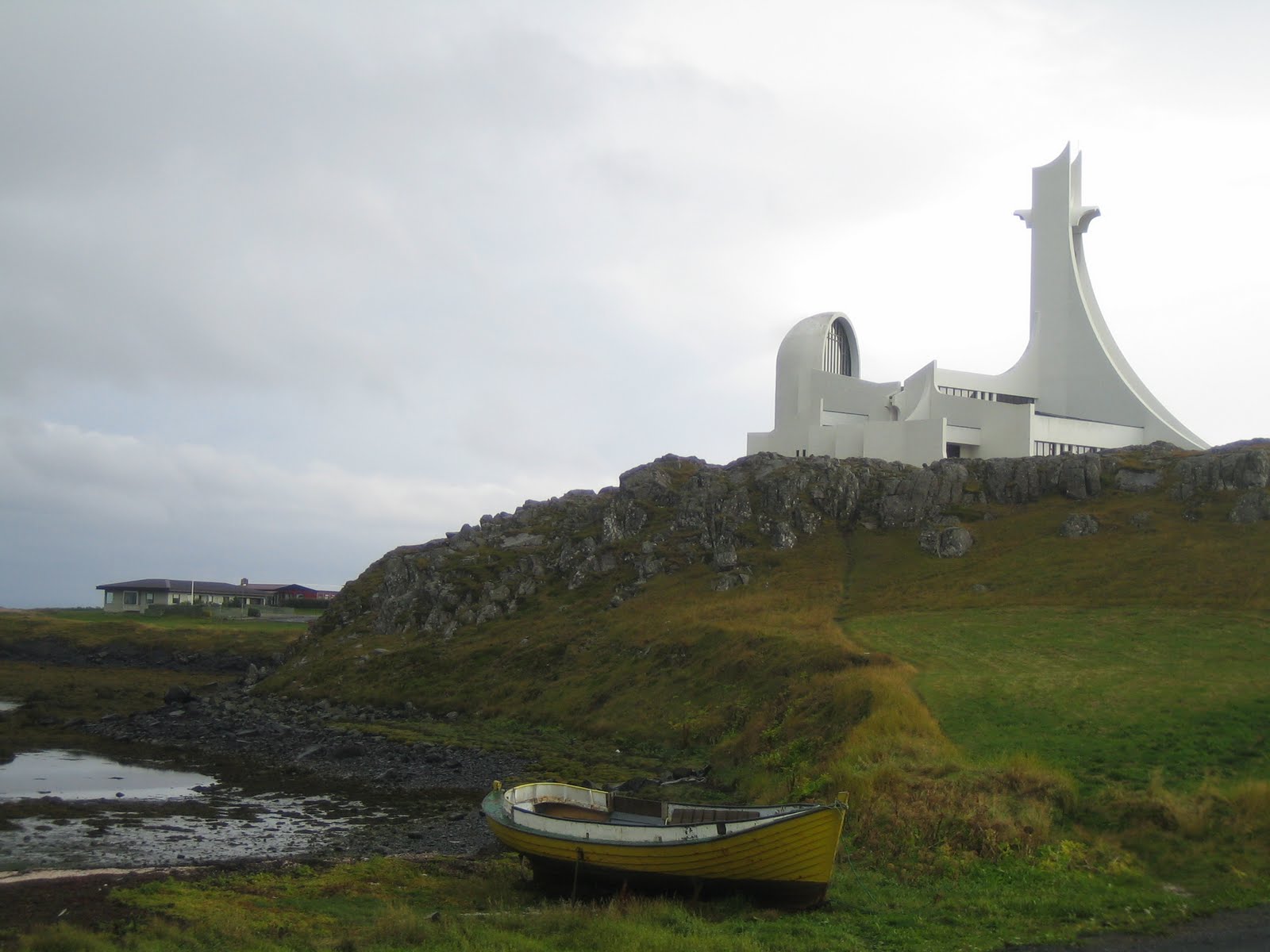
He showed us the space and filled us in on local politics, and let us know that he also works at the volcano museum, he helped build the modern church in the town (photo below), and that he also runs the town's newspaper!

After looking out at the contemporary church, I couldn't help but be magnetically pulled to it. Thankfully this church was open, and it was amazing inside and out! The ceiling is lit by hundreds of single bare lightbulbs, and there is this incredibly strange and delightful painting on the altar of a Madonna and Child. But look closely, and you realize that Mary and Babe are floating over a landscape of lava and volcanic terrain. How appropriate!

I did play piano in here, there was a beautiful Steinway and it would be really fun to come back and give a concert.

Then we drove...and drove some more...there are mostly fields and farms in this area (and rainbows), but on the way we stopped at a réttir, or sheep roundup! It's that time of the year.

The sheep here pretty much roam free, but their ears are tagged. Then farmers and townspeople are recruited to go get the sheep, they bring them to a pen like this (or some are circular, as you may see in pictures later in the week) and put all the sheep in the middle. Then the sheep are sorted and put in side pens depending on whose they are! I hope the locals didn't mind that we took pictures of all the animals. And by animals I mean these kids playing in the dirt.

Thanks to a suggestion by an architect colleague, we stopped at Viðimiri Church, which was built in 1834. It was also closed, but it had a fabulous exterior of wood, sod, and colorfully-painted ornaments with a green fence surrounding.

We arrived in Akureyri, the 'Capital of the North' of Iceland with a whopping 17,000 people. It took has a modern church (pictured) and a great new circular city hall (at least I think that's what it was).

It's still a 'town' by U.S. standards, but after all those farms and fields on the drive today, Akureyri feels like a metropolis. There are bars! Fancy clothes. Angsty teens. Thai food! We ate some for dinner, and went for a post-prandial cocktail at this funky place with hammered metal tables, woven basket lamps, and cow hides on the walls.

Devon said that if we were to write a review for Akureyri, it would be for the Hostelling International (HI) and it would be a very glowing one. That place is nicer than some hotels I've stayed in! Sinks in every room. A veranda overlooking trees to eat your morning cereal while you use free wireless. And friendly staff too. Bravo. Day 3 coming up ahead.

Saturday, October 02, 2010

Ring Road Trip Day 1: Snæfellsness

And we're off! Nicole, Devon, and I are travelling Iceland's Ring Road for a week. The Ring Road, aka Route 1 aka Hringinn, is the main highway that encircles the entire country of Iceland, which makes for convenient stops to many of the country's most beautiful places. Route 1 is a multiple-lane highway in Reykjavík, but soon after leaving the city, it is basically a two-way road with singe-lane bridges, and some of it is still gravel. We leave Reykjavík and head for Snæfellsness peninsula, with a few recommendations of things to see, places to visit, and places to stay, but we have only a basic itinerary and leave much of the day's schedules up to chance. Nicole has a fancy camera, I have a digital recorder and a new guidebook, and Devon is our trusty driver, being the only one of us able to drive a 4x4 stick shift. Thank goodness he didn't break his leg on the trip or we'd have been stranded, learning to drive a manual over some lava formations or crashing into some glacier.

I think the best way to narrate the trip is to go day by day, so you'll get a new post for each day of the excursion. Here is Day 1.

We stopped along the way at Bjarnafoss, the first of innumerable immensely beautiful waterfalls. I took a recording of the runoff and began a small obsession with water sounds during the whole week's trip.

We passed through much of the nearby sights to get to the town of Olafsvík. Not much to see here, really. Hate to break it to you, but Olafsvík smells a lot like fish, there isn't much to see or do, especially in the winter season when tourism dies down (and we are travelling alone on the highway much of the time, not seeing a soul), one bakery, one pizza place and one place called the 'Hobbitinn'. There is a nice modern church there, though. Sadly it was locked, no peeping inside to be had.

Thanking the four-wheel-drive every kilometer, we drove through Snæfellsjökull National Park and I saw some of the first jaw-dropping landscapes of the week. I should also say that I was also impressed by what we couldn't see–the fog near the glacier was so intense that much of the drive felt like driving on another planet.


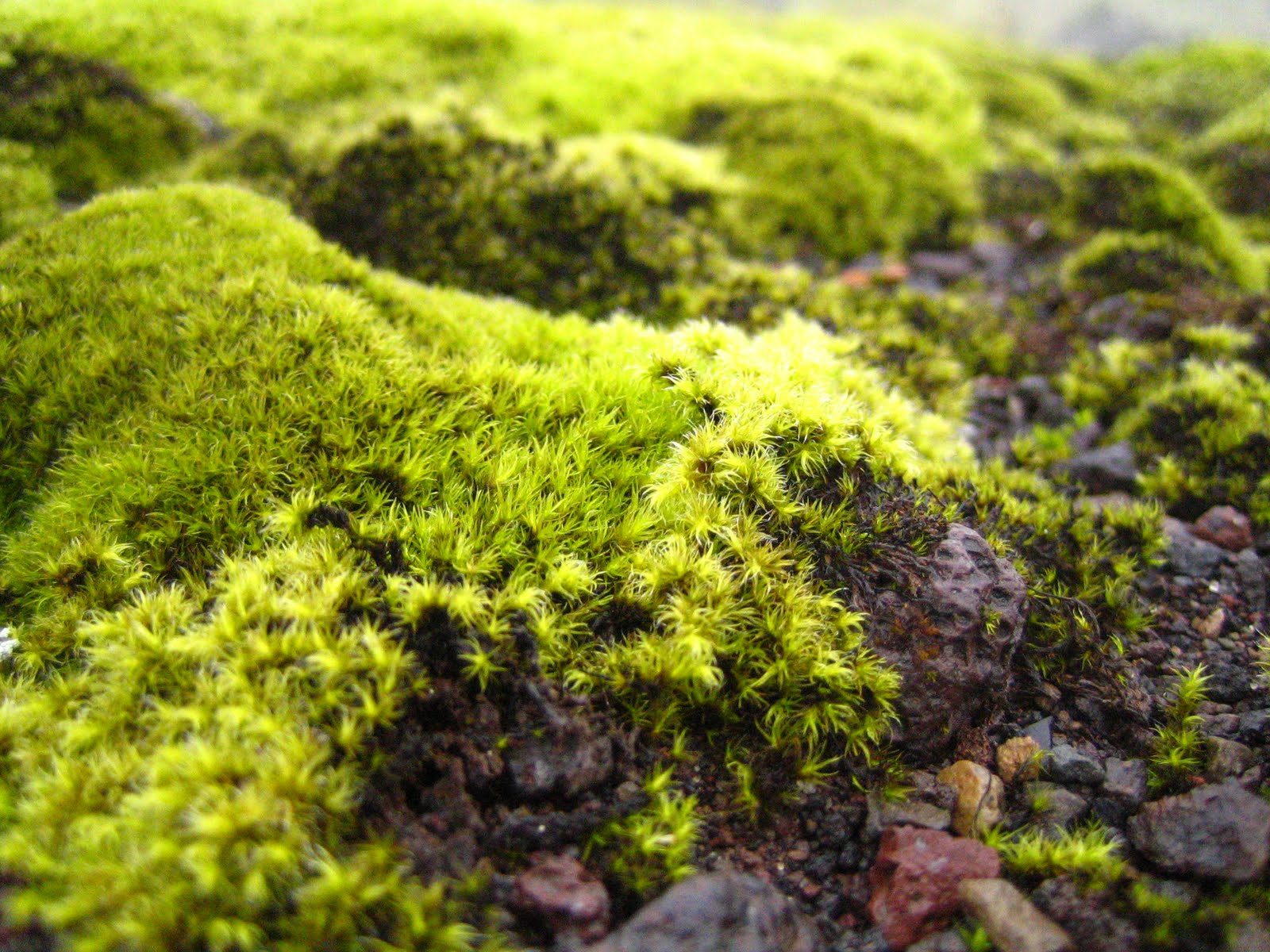
We did stop to take a few pictures in a mossy-covered area, and we looked for the glacier but it remained elusive. Not surprising either, seeing how it is small to begin with and is shrinking at an alarming rate, and may be totally gone within 10 years.

We drove down the mountain and stopped at a parking area with a picnic bench. Little did I realize that this spot would be one of the best places I visited on my trip-Sönghellir, or 'Singing Cave'! You can crawl under this overhangy rock and stick your head in the pitch-black darkness, and once you get over being in a dark cave and peeing your pants a little bit you realize that the acoustics in the space have a beautiful 3-second or so resonance. I could sing and make chords with my own voice! Naturally we recorded a little improvisation of singing tones inside, so we'll see if I can make some use of it. The info board by the side of the road was priceless, it read something like: "Legend has it that some old Saga character lived in the cave, when at the time many people were afraid of the cave because you could hear 'dwarf-speak' (also known as 'echoes'.) But so-and-so Viking guy didn't mind the dwarf-speak, because he was raised by dwarves." Good for him, combating racism in the tenth century.

Continuing on, we stopped at a small town called Arnarstappi as I saw a cool-looking monument made by the artist Ragnar Kjartansson.

But surprise, the town had something up its sleeve: a walkway out to stunningly dramatic cliffs and rock formations on the coast!

Arnarstappi has a short walking path (or an even shorter drive) to the neighboring village, where the coasts were even more up close and personal. The rocks here on the shore get worn down smaller and smaller, but don't turn to sand- they stay like pebbles and crackle and clack together as the tide goes in and out. What a surprising sound to hear. And another surprise was waiting for us when a small café appeared out of nowhere, sheltered on the mountainside. And it was open! It was probably an old fishing house at one point, but the interior was now charming and intimate. The hot cocoa was amazing.

Back in the car, we drove along the south of Snæfells peninsula to arrive at our dinner location extraordinaire- Hotel Buðir. I was told by a couple colleagues that if there was one time to splurge on a meal during my trip this would be it. And coincidentally, it was my birthday, so I had extra excuses to celebrate. The meal did not disappoint. The restaurant is tucked in an old Hotel, and is probably one of the most elegant and fancy meals in the whole country. The hotel is also next to an old church, which had a brief role in the film 101 Reykjavík.

I had puffin as an appetizer! Twas my first crazy Icelandic specialty food, which tasted like a smoky, chewy steak. It was definitely not what I was expecting, but I can check that off the list (next up: whale meat). The main course was a trout entreé featuring potatoes, greens, and 'cilantro ash'- a literal experiment on volcanic food. It was incredible, probably the best fish I've ever eaten, as it was the ultimate in Local food (caught outside, about 100 yards away in a boat in the sea) and Fresh (caught about a couple hours before it's in my stomach). The restaurant even made a very fancy vegetarian entreé for D.

There was no one else in the whole place until we were ready to leave, so we had our waiter all to ourselves. Such is the off-season in Iceland, I suppose; the tourists fade away and I can eat my cute wild birds in peace.


Ending our meal, we drove to Stykkishólmur to spend the night in a hostel, and wait patiently until our appointment tomorrow at Vatnasafn, artist Roni Horn's installation/building 'Library of Water'. More to come!